These are a few of the Features you'll find in
FlightLog Analyzer
Each display has multiple configuration options, of which just a few examples are shown here
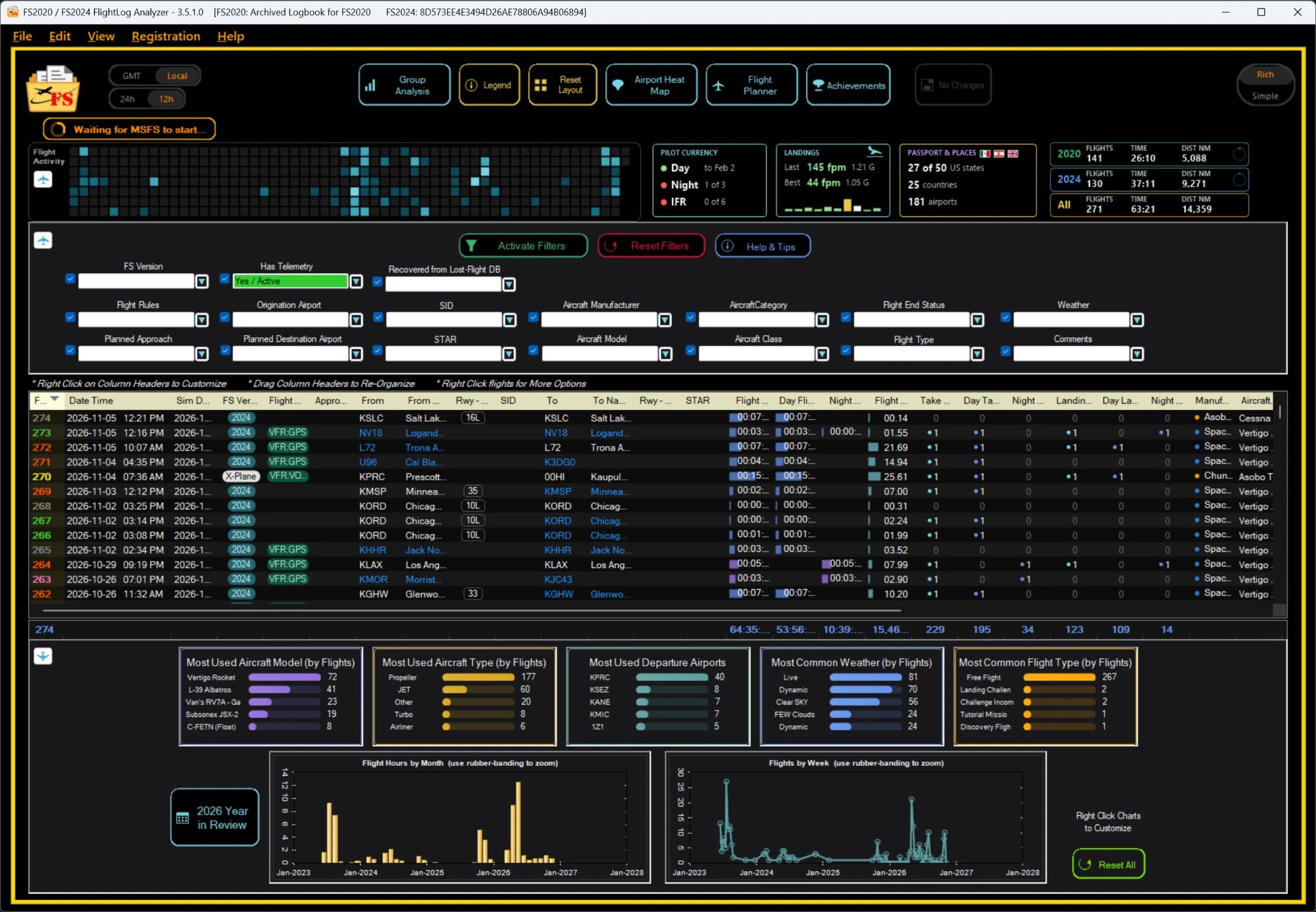
Main Display
FlightLog Analyzer displays flight information detailing each flight you've made. The flights are pulled directly from Flight Simulator's Logbook.
From the Main Display, you'll have the option to Summarize, Graph, Export, Edit and Fix your Flight Simulator Logbook.
* Consolidate your FS2020 and FS2024 flights into a single view.
* X-Plane 11 & 12 logbooks can be imported and consolidated into the view too!
* Filter the view of flights by multiple criteria. As an example, show only 'Flights from Particular Airports', 'Flights in Particular Aircraft', or 'Flight in Particular Weather'.
* Display flight time in either 12 hour or 24 hour format, as well as Local Time or GMT.
* Logbook columns are Sortable, and can be Re-ordered to suit your needs.
* Cards across the top show your Flight Activity calendar, Pilot Currency, Landings, Places Flown and FS2020 / FS2024 totals at a glance.
* Pie Charts shows 'Percent of Logbook Capacity' currently being used.
* Charts & Graphs show visual statistics about your flights.
* Shown here in Dark Mode, perfect for low-light cockpits. A Light Mode is available too, if you prefer a brighter screen.
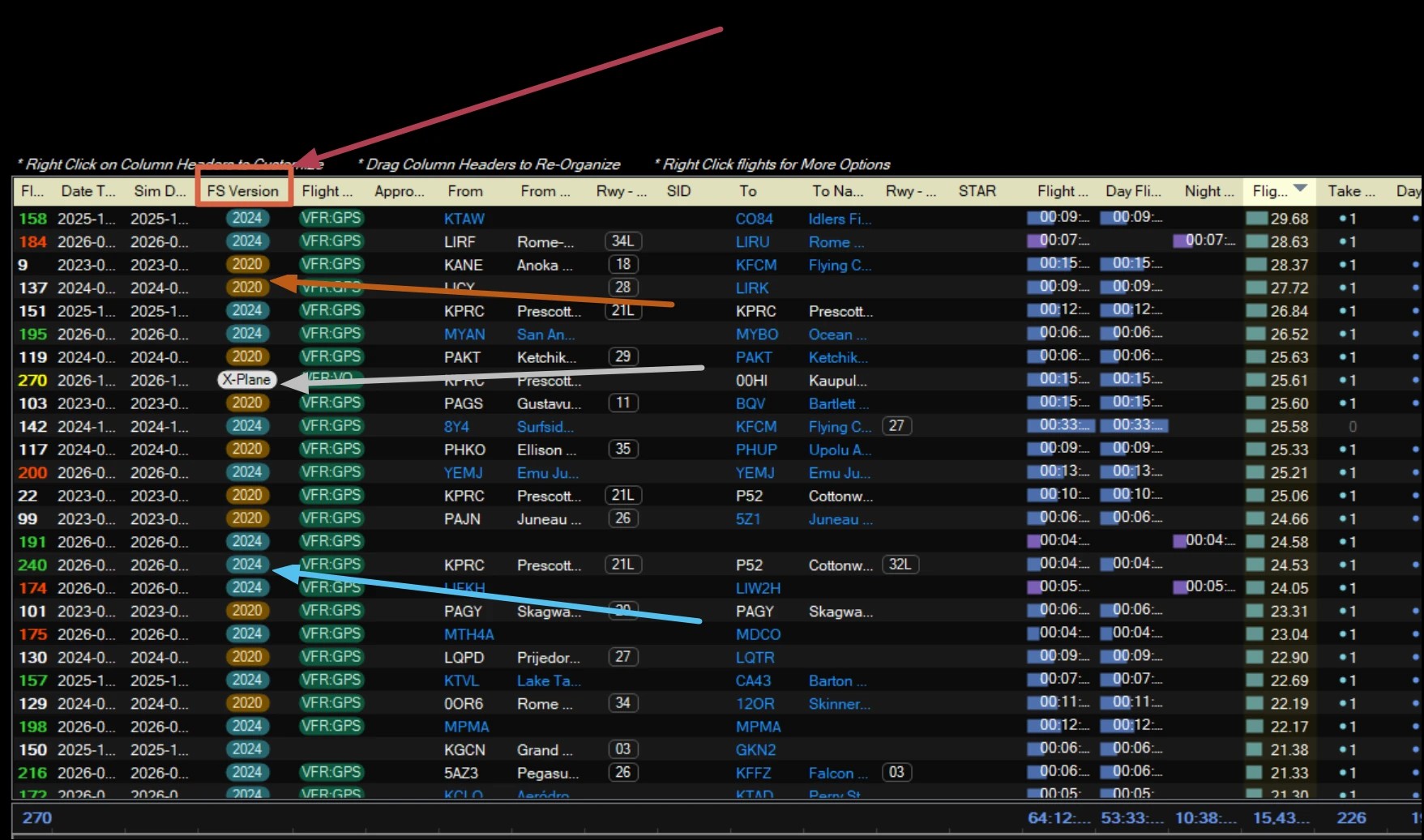
Seamless Consolidation of FS2020 / FS2024 and X-Plane Flights
FlightLog Analyzer provides an integrated and seamless overview of your FS2020, FS2024 and X-Plane flight data, all on one display.
The Group Summary and Analysis feature can then process statistic 'by FS Version'.
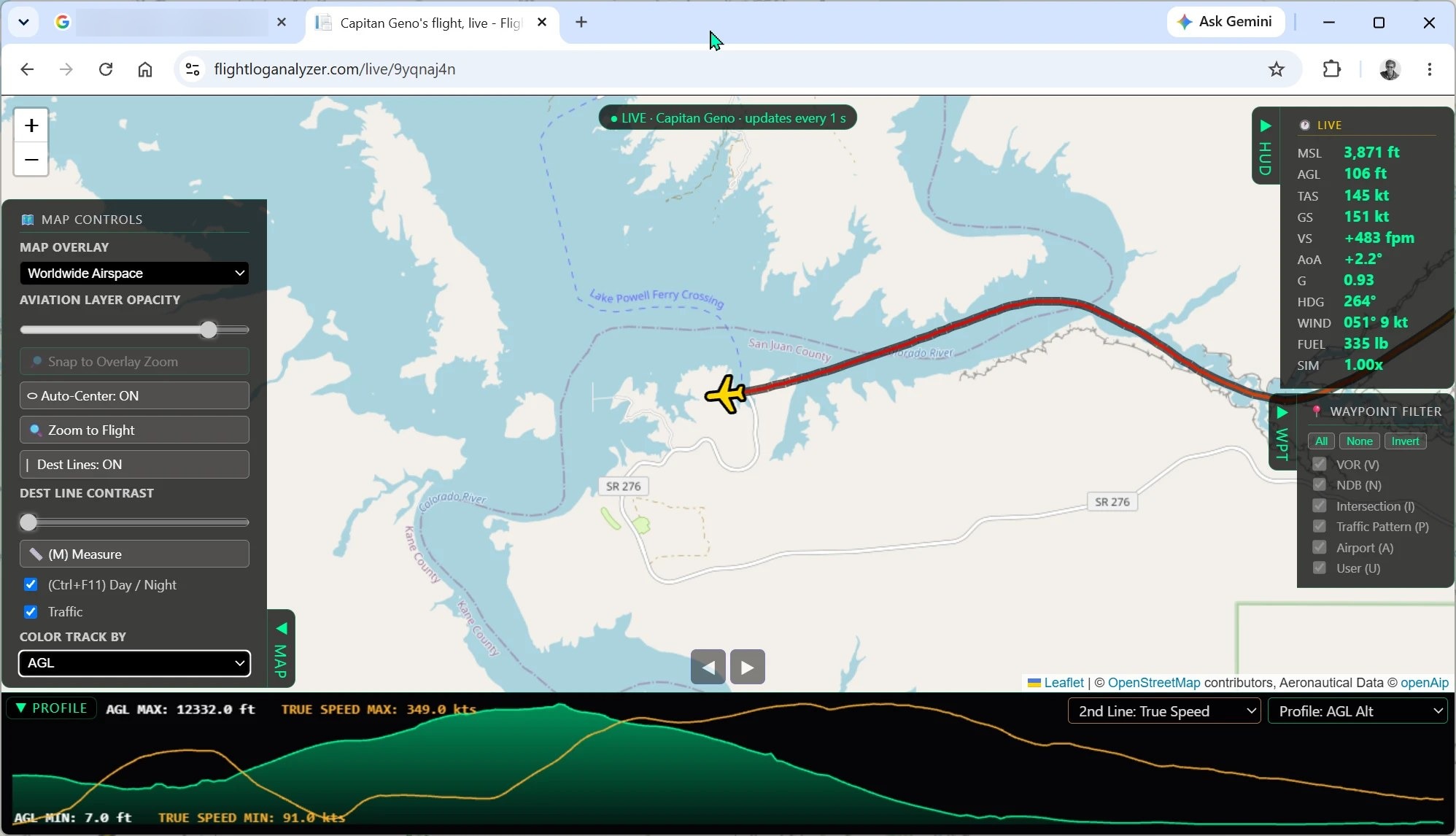
ATC View — Live, Anywhere
The ATC View is a live moving map of your flight as you fly it: your track over the aviation charts, a HUD with altitude, speeds, wind and fuel, and an altitude profile with your route’s terrain, along with the traffic around you.
NEW: Share your flight live with everyone you know, anywhere in the world. One link, as many people watching as you like.
One click gives you a link. Whoever opens it watches you fly, on this same live map, in any web browser on any phone, tablet or computer — no app, no account. The screenshot is exactly that: one of the friends following along over Lake Powell.
* Share Your Flight Live (PRO): family following you across the ocean, a friend watching your approach, a group flight keeping an eye on each other. Joining partway through shows the whole flight so far.
* Tablet View: the same ATC View on an iPad, Android tablet or phone on your home Wi-Fi — walk away from the PC and keep an eye on the autopilot.
* Top of Descent Alert: a chime before it’s time to start down, and optionally a sim pause until you’re back.
* Nearest Airports, Traffic, a Measure tool, Day/Night shading, and track coloring by altitude, speed and more.
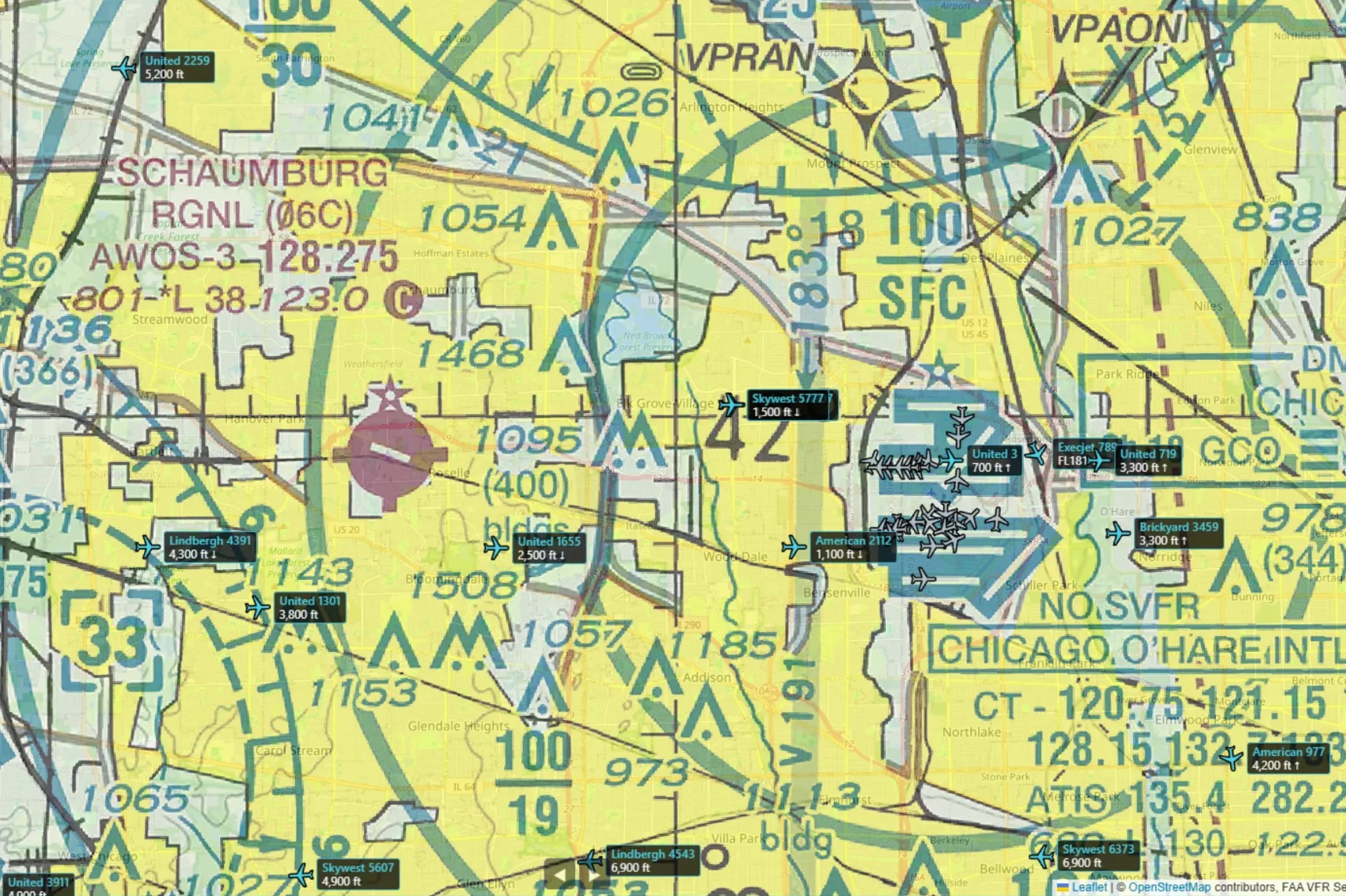
Traffic on the Live Map
See the other aircraft around you on the ATC View and the Tablet View, each turned to its heading and labeled with its callsign and altitude, gliding smoothly between updates.
That’s whatever Flight Simulator has loaded within about 100 nm: its AI and live traffic, multiplayer pilots, and VATSIM or IVAO pilots your vPilot, xPilot or Altitude client brings into the sim.
* Click any plane for its type, altitude above sea level and above the ground, speed and vertical speed, updating while the popup is open.
* A busy airport stays readable: parked aircraft are left out, and labels of aircraft on the ground wait until you zoom in close. The screenshot is O’Hare at a typical zoom.
* Turn it on or off with the Traffic checkbox in MAP CONTROLS.
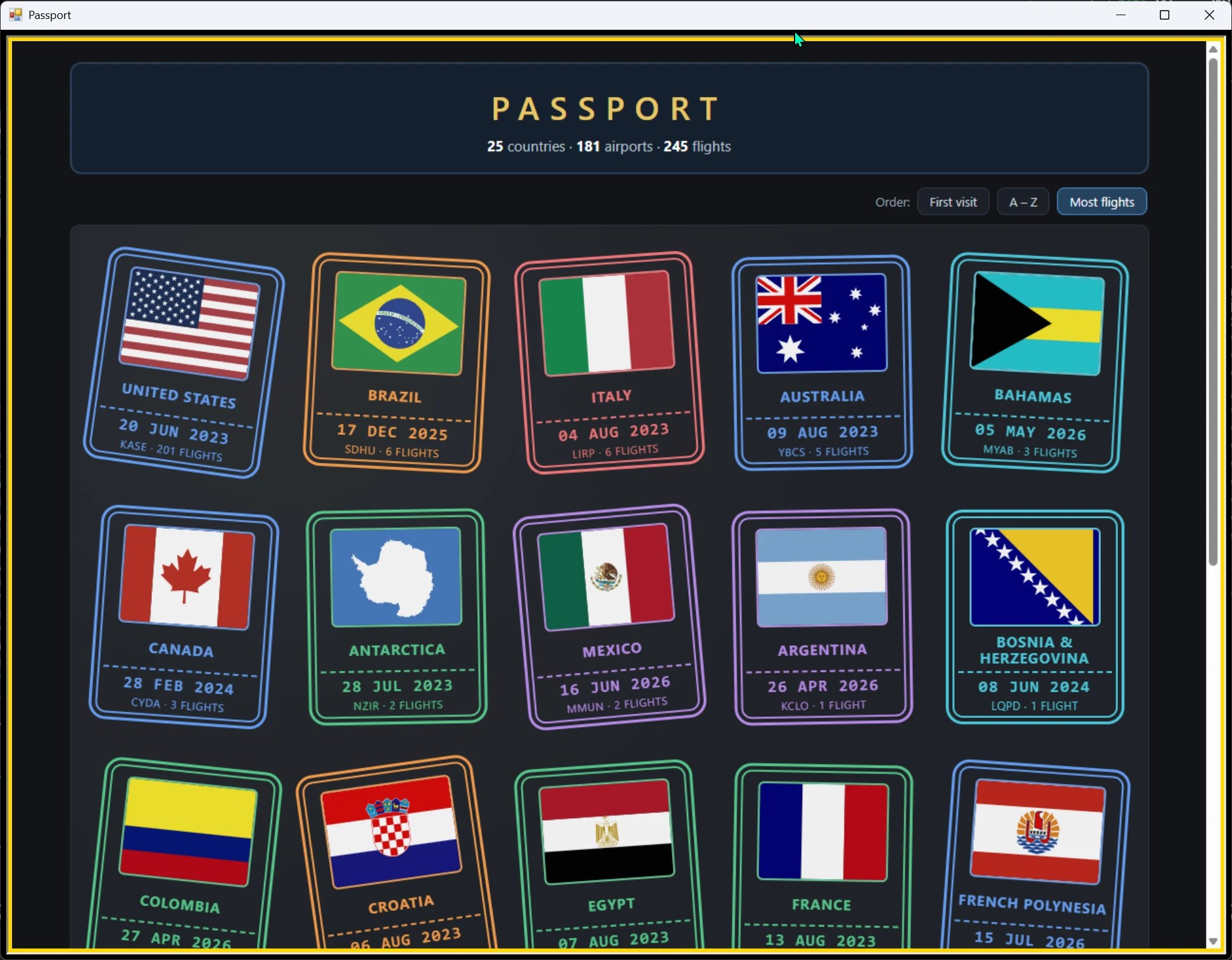
Your Passport
Every country in your logbook gets its own passport stamp.
Open it from the Passport button in the Places Flown window, just below.
* Each stamp has the country's flag, the date of your first flight there, and the airport you used.
* Tilted and inked in different colors, like the real thing, in dark and light mode.
* Put the stamps in order of first visit, A – Z, or most flights.
* Rest the mouse on a stamp to see how many flights and airports you have there.
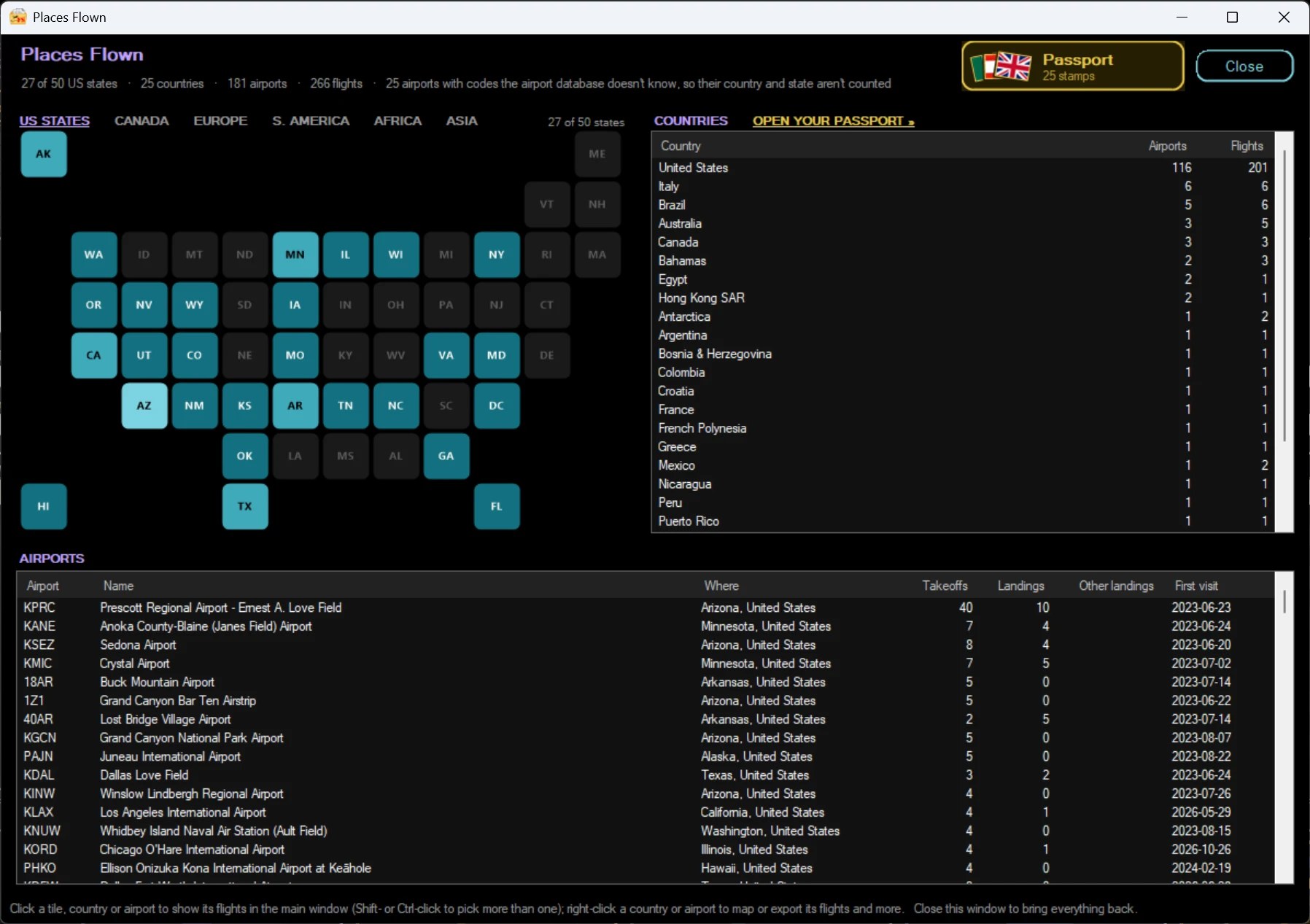
Places Flown
Places Flown keeps score of everywhere you've been: how many US states and Canadian provinces, how many countries, and how many airports.
A card on the Main Display shows the totals at a glance. Click it for the full picture.
* Tile maps of the US States, Canada, Europe, South America, Africa and Asia light up every place you've taken off from or landed in.
* Countries and Airports lists, with takeoffs, landings and the date of your first visit.
* Touch-and-goes and stops along the way count too, not just where each flight started and ended.
* Click a state, country or airport to show just those flights in the Main Display (Shift- or Ctrl-click to pick more than one).
Mission Debriefer
Mission Debrief combines an Aerial Map and Profile View of your previous flights, letting you analyze any flight attribute at any point in time.
This animation demonstrates how each point along the flight can be reviewed in detail during a post-flight debrief.
* Coloring of the flight path gives a visual representation of how the selected attribute changed during the flight.
* Attributes such as Altitudes, Air Speeds, Vertical Speed, and G-Load.
(available when FlightLog Analyzer has been run in conjunction with FS202X to collect Real-Time Telemetry)
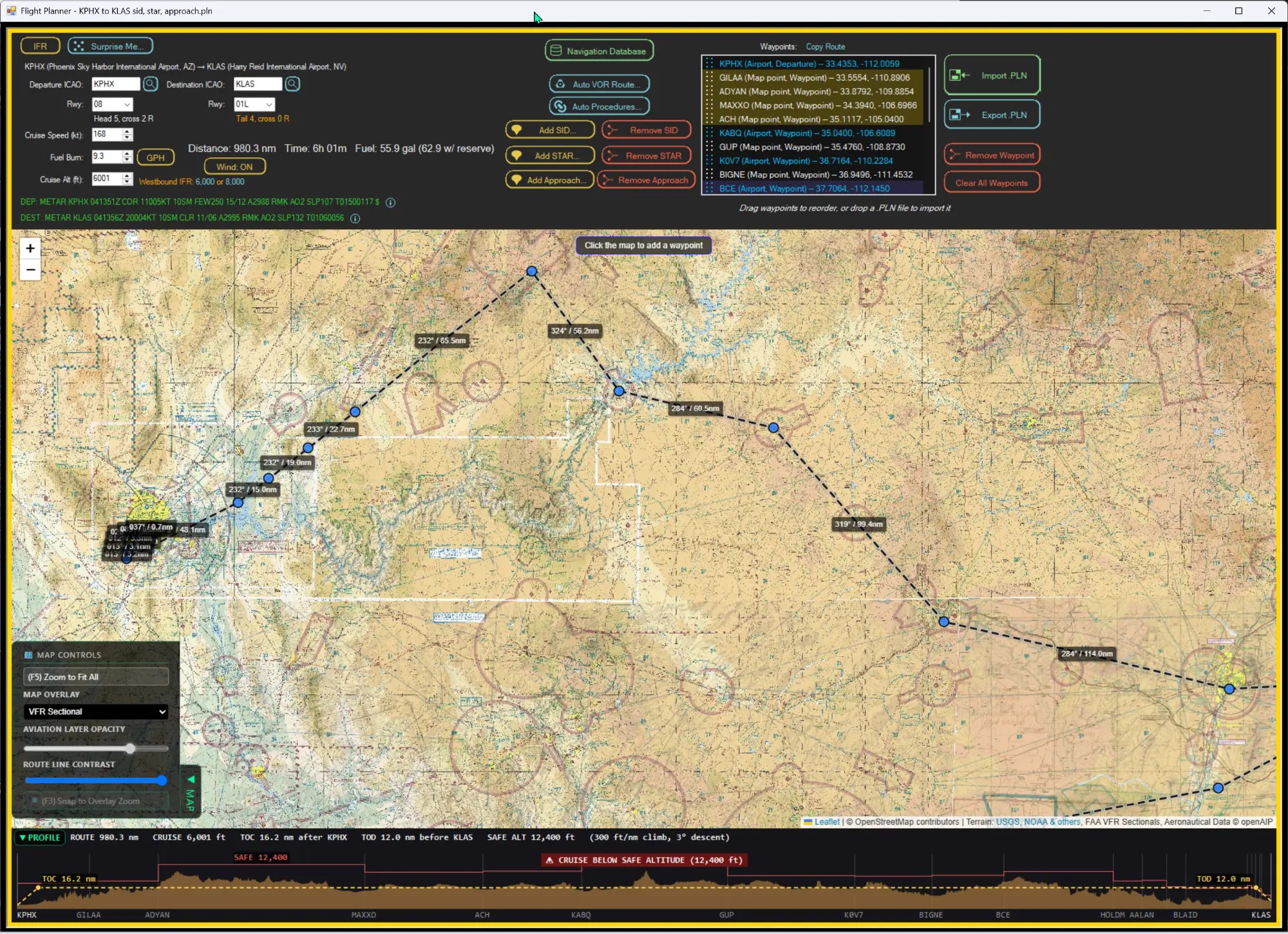
Flight Planner
The Flight Planner lets you build a complete route on an interactive aviation chart, then send it straight into Microsoft Flight Simulator.
Enter a departure and destination, click the map to add waypoints, and choose real published Departure, Arrival, and Approach procedures for either airport.
A route can include:
- Published SIDs, STARs, and Approaches, added by name with their real charted waypoints
- Airports, VORs, NDBs, and named Fixes, added by clicking the map or typing an identifier
- Automatic Distance, Time, and Fuel Burn calculations, with optional Winds Aloft factored in
* The map can display a VFR Sectional, IFR Low/High, TAC, or Worldwide Airspace overlay, in either Light or Dark Mode.
* Finished routes Export directly to a .PLN file MSFS can load from its own World Map, and an existing .PLN can be Imported right back in for editing.
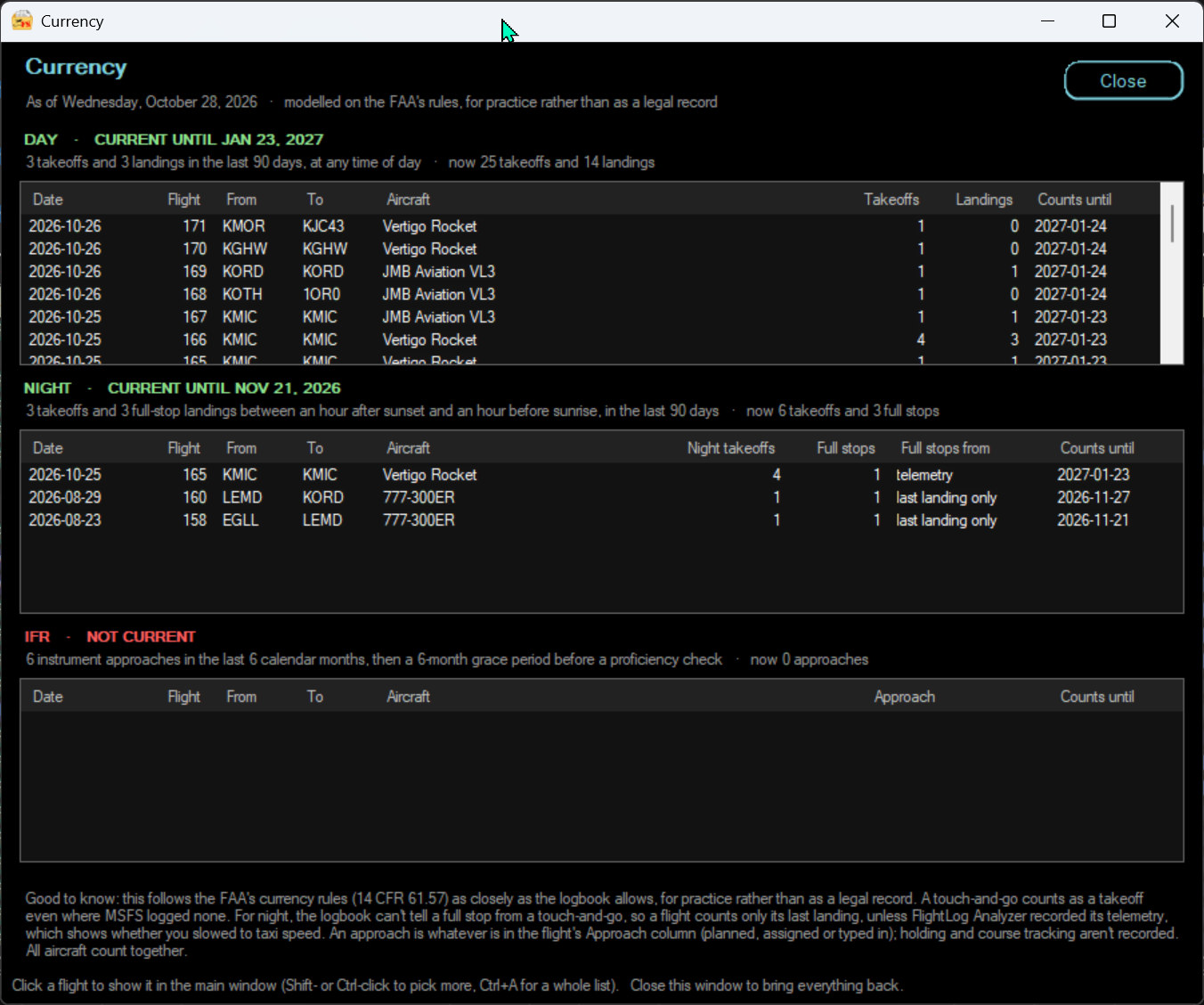
Pilot Currency
Stay current like a real pilot. FlightLog Analyzer checks your logbook against the FAA's currency rules for Day, Night and IFR flying.
A card on the Main Display shows each one green, amber or red, with the date it runs out.
* Day: 3 takeoffs and landings in the last 90 days.
* Night: 3 takeoffs and full-stop landings between an hour after sunset and an hour before sunrise, worked out for where you were and the time in the sim.
* IFR: 6 instrument approaches in the last 6 calendar months, then a 6-month grace period.
* See every flight that counts, and the date each one stops counting. Click one to show it in the Main Display.
Landing Log
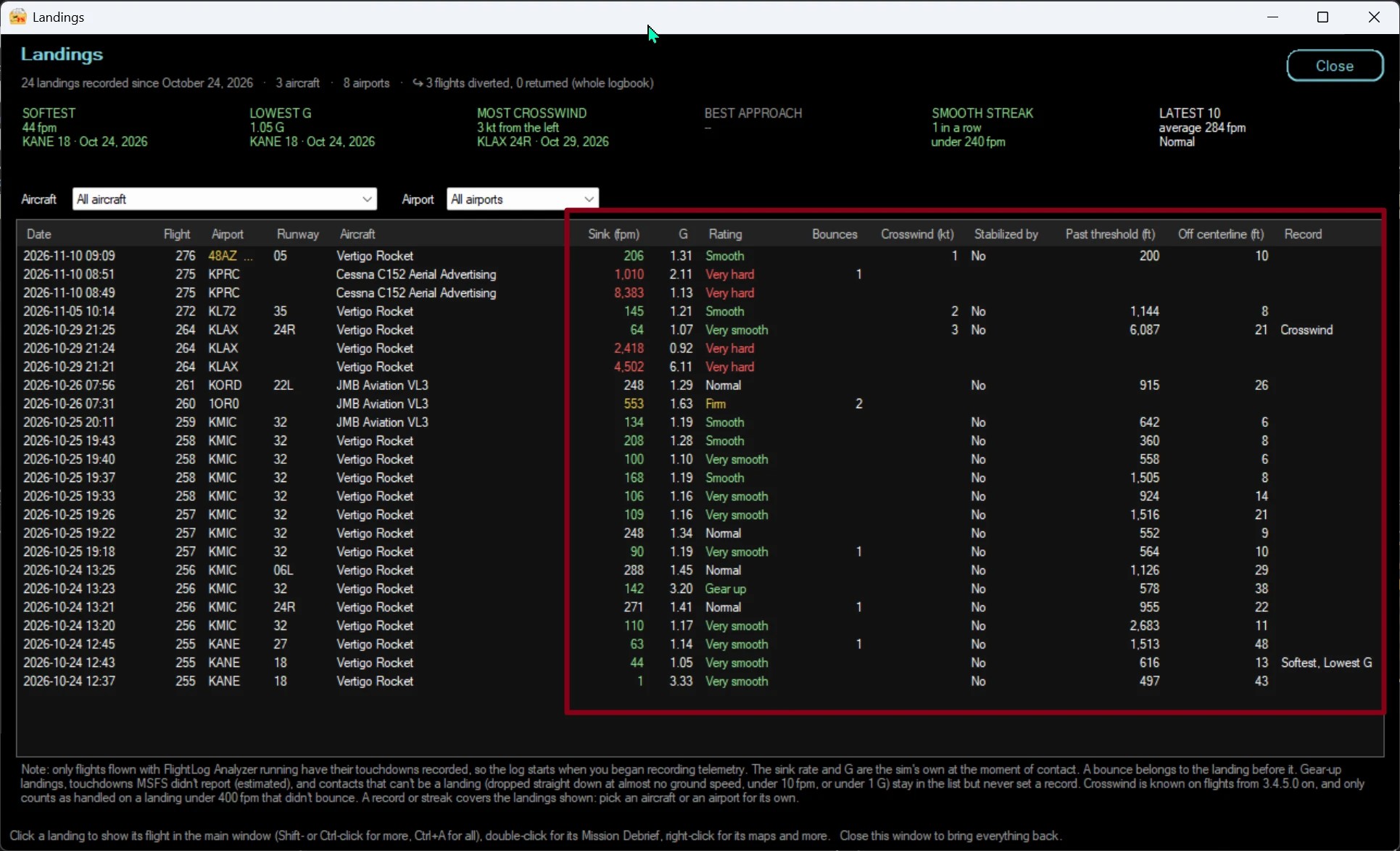
How good are your landings, really? FlightLog Analyzer records every touchdown while you fly and keeps a log of them all.
A Landings card on the Main Display shows your last landing, your softest ever and your latest ten. Click it for the whole log.
* Every landing rated from Very smooth to Very hard, by the sim's own sink rate and G at the moment of contact, with any bounces.
* The crosswind on the runway you landed on, and whether your approach was stabilized by 1,000 ft or 500 ft.
* Exactly where you touched down: feet past the threshold and feet off the centerline.
* Personal records: softest, lowest G, most crosswind, best approach, smooth streak and the average of your latest ten.
* Pick an aircraft or an airport to see your best in each one. Double-click a landing for its Mission Debrief.
Flight Map Viewer
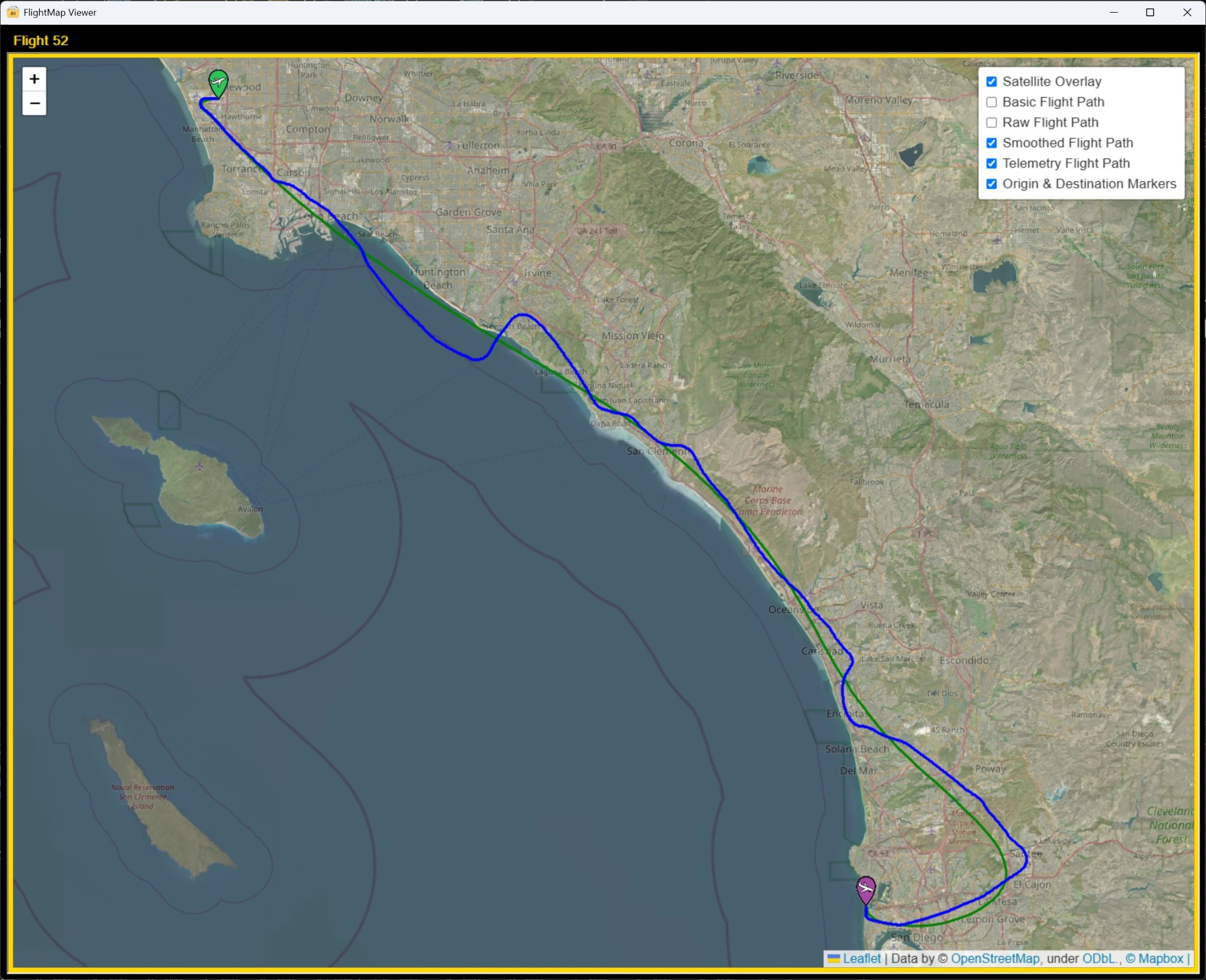
The FlightMap Viewer provides an aerial, map‑based view of your previous flights, letting you revisit each route exactly as it unfolded.
This example shows the Flight Path using the Built-In viewer.
* Attributes such as Map Type can be controlled via Option Selections on the display.
This image shows an example of the Satellite-Overlay map view.
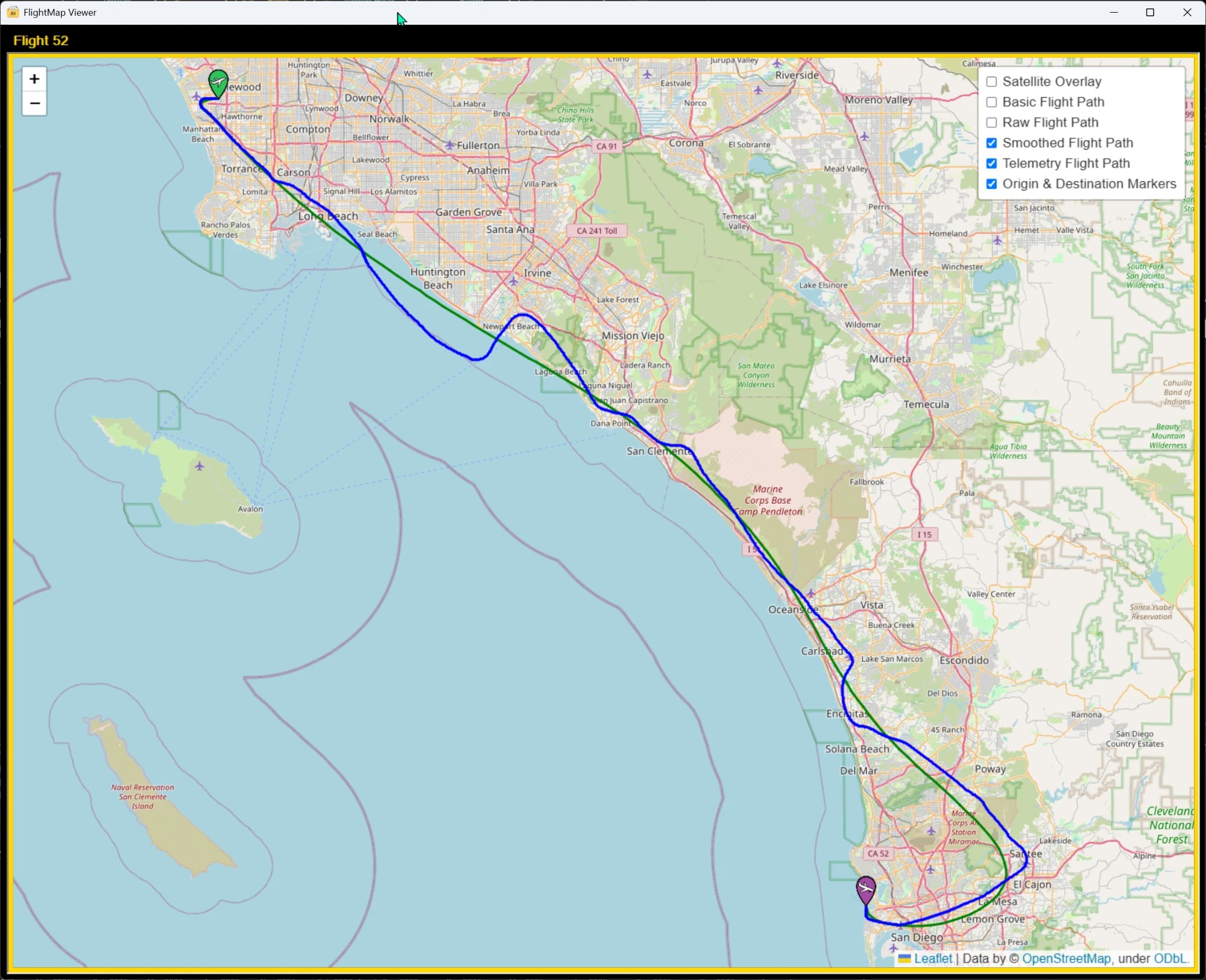
Flights can also be displayed on Standard Maps without satellite overlays as well, more easily identifying roads and cities.

As well as using the Built-In FightMap Viewer, an external "KML Viewer" can be used to display the path of your flights.
Google Earth® is an example of a popular KML Viewer that will integrate seamlessly with FlightLog Analyzer.

Another example of maps created with Google Earth® integration.
* for seamless integration, the Google Earth® app needs to be installed separately on your system. It is not part of FlightLog Analyzer.
(even without seamless integration, a KML Export can be imported onto the Web Browser version of Google Earth)

Google Earth® integration let's you rotate / zoom the map to see your route from any perspective,

This example of Google Earth® integration shows how the Altitude Profile can be displayed along with the Flight Path.

Flight Profile Viewer
The Flight Profile Viewer displays the Altitude Profile of your flights in Graphical form.
Flight Altitudes can be plotted against either Flight Time or Flight Distance.
Altitudes are shown in:
- MSL Altitude (Mean Sea Level)
- AGL Altitude (Above Ground Level)
- and the Ground Elevation

Flight Profile (with True Airspeed)
When Flight Simulator's SimConnect Telemetry has been collected for the flight, True Airspeed is also included on the Altitude Plot.
Achievements Progress Tracker
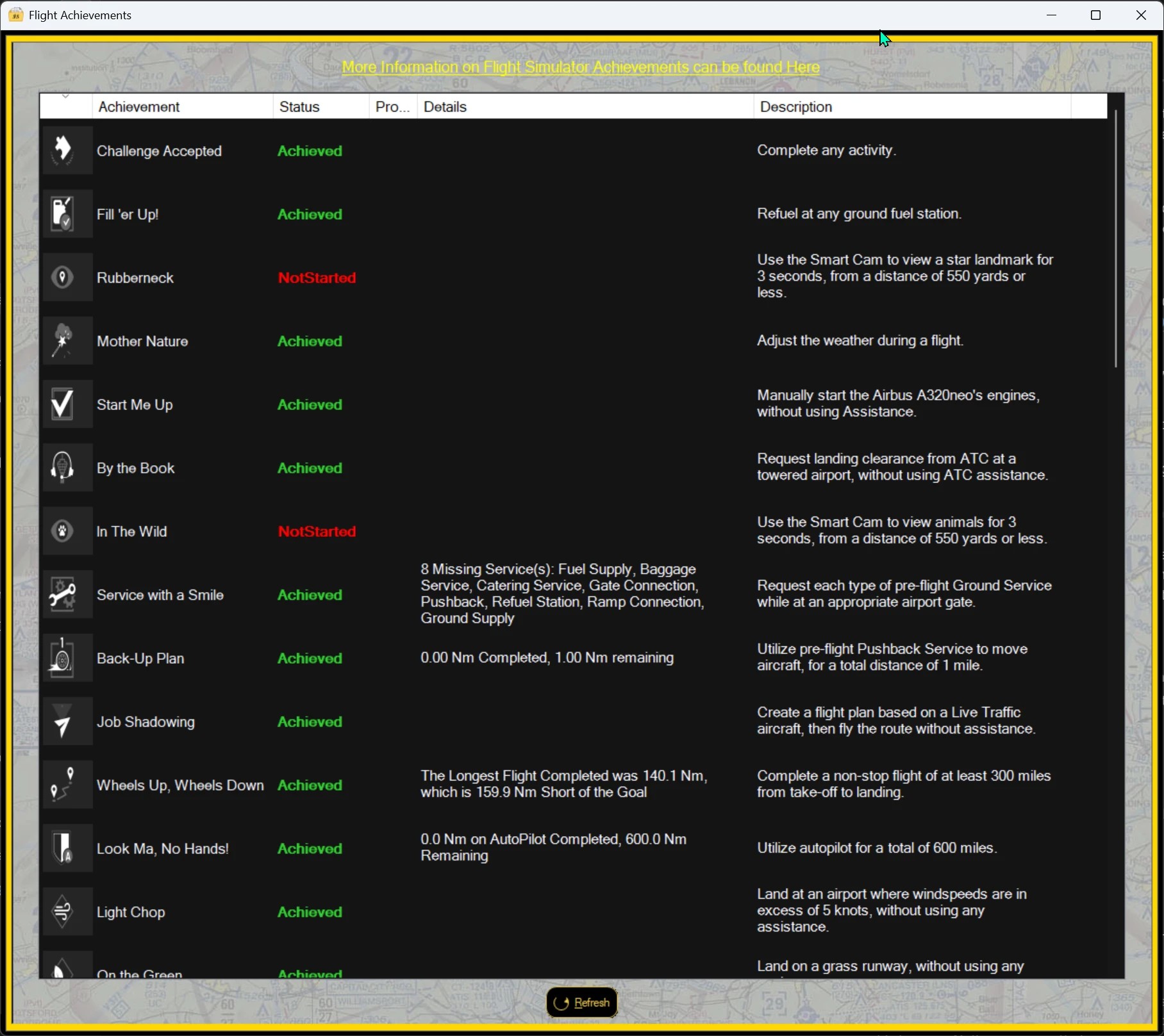
The Achievements Progress Tracker provides comprehensive assistance in evaluating outstanding objectives necessary to complete your 'FS Achievements'.
Achievements are broken down into 'What Has Been Completed' vs 'What Needs to be Completed'.
Group Analysis & Summaries
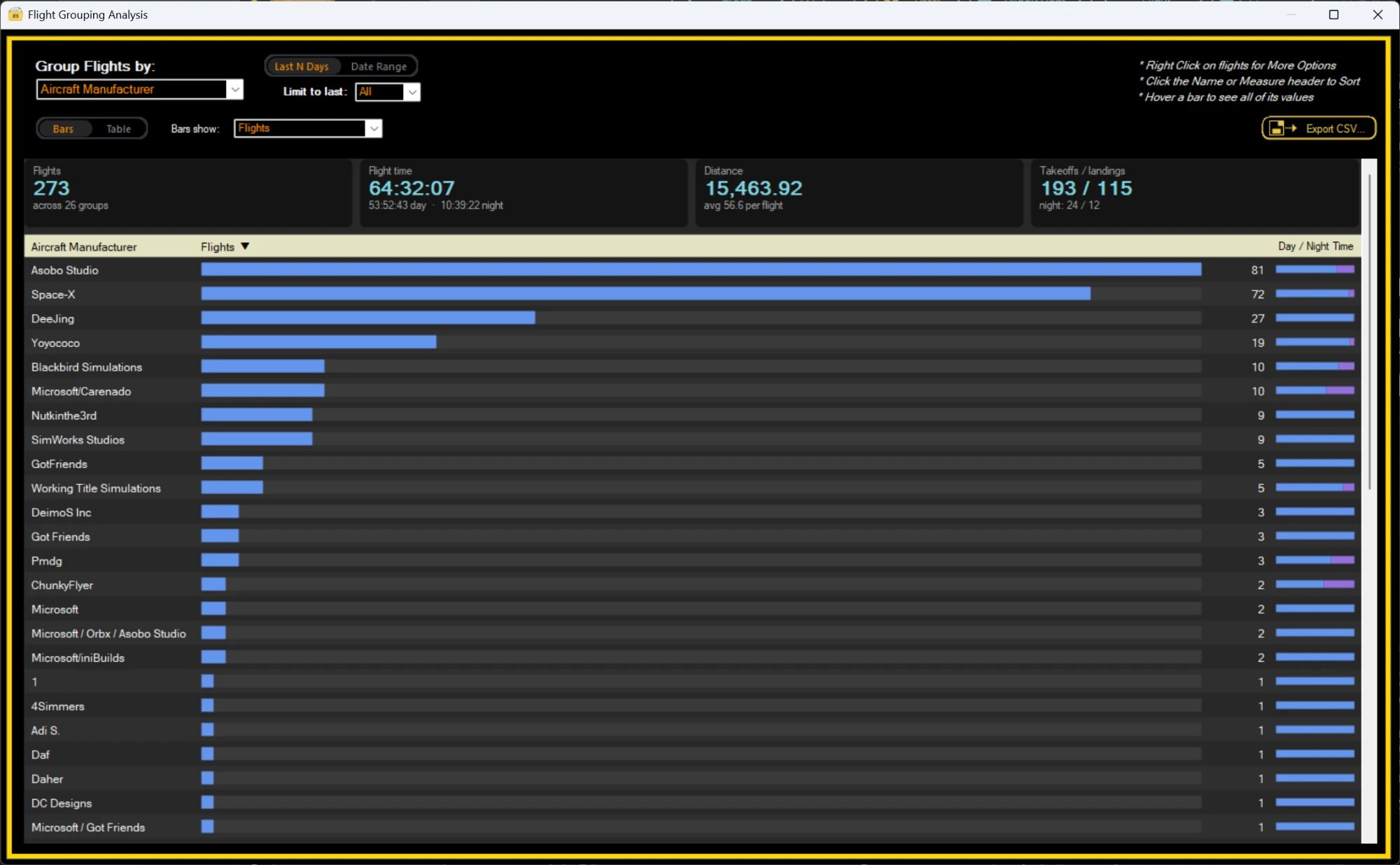
Flight Group Analysis allows flights to be Categorized and Summarized by various Flight Attributes.
Shown here, flights are summarized by "Aircraft Manufacturer" in the new Bars view, sorted by flights — ranked bars for an at-a-glance read, with summary cards across the top and a day / night strip on every row. One click switches to the classic Table view (shown next) with the very same data.
* Analysis is performed across the consolidated flights of both FS2020 and FS2024
* The Analysis Date Window can be filtered by "Limit to last:" days or by specifying a Date Range
Examples of these Summary Flight Attributes include:
- 30, 60, 90 Day Summaries
- Aircraft Type
- Aircraft Model
- Weather Conditions
- Type of Flight ( Discovery, Free Flight, Tutorial Missions, Landing Challenges, etc )
- Flight End Status ( Success, Crash, Unsuccessful Mission, Incomplete, etc)
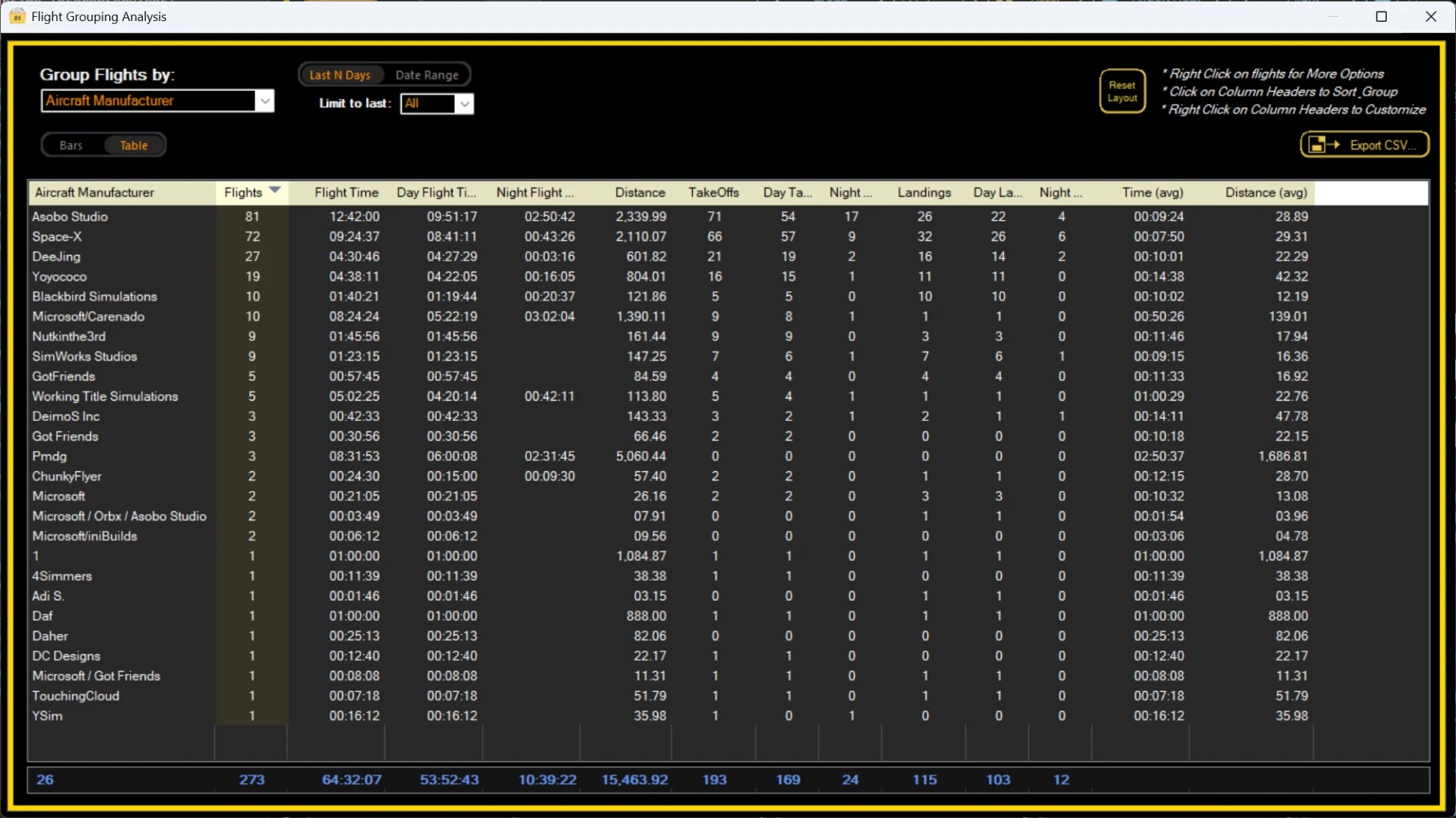
The same data in the classic Table view.
Every measure gets its own column — flights, flight time (day and night), distance, takeoffs, landings and the averages — with totals along the bottom.
* Click a column header to sort; right-click the headers to choose which columns to show, and use Reset Layout to put them back.
* Switch between Bars and Table at any time with the toggle at the left.

Flights summarized by Aircraft Types.
This provides a breakdown of how many flights, how much flight time, how many Takeoffs and Landings, etc for each 'Type' of aircraft.

Flights summarized by a 30 / 60 / 90 day sliding window.
Flight data is broken down by the number of days in the past.

Logbook Cleaner
The Logbook Cleaner allows you to Permanently Delete unwanted flights from Flight Simulator's Logbook.
'Quick Select' options are available to automatically identify 'Short' flights or flights that 'Ended in a Crash'.
* Note: a PRO level license is required for this feature

Flight Fixer
The Flight Fixer allows you to correct flights that have Missing Takeoffs and Landings.
'Quick Select' options are available to automatically identify the flights that are Missing either Takeoffs or Landings.
* Note: a PRO level license is required for this feature

Logbook Backup & Restore
Restore Points are automatically generated each time you Delete flights from the FS Logbook, allowing you to Revert back to a previous version anytime you need to.
Simply select a Logbook Backup by the Date and Time it was created.
You can also create a Logbook Backup on demand, giving you the power to manage and organize your flights as You want to.
